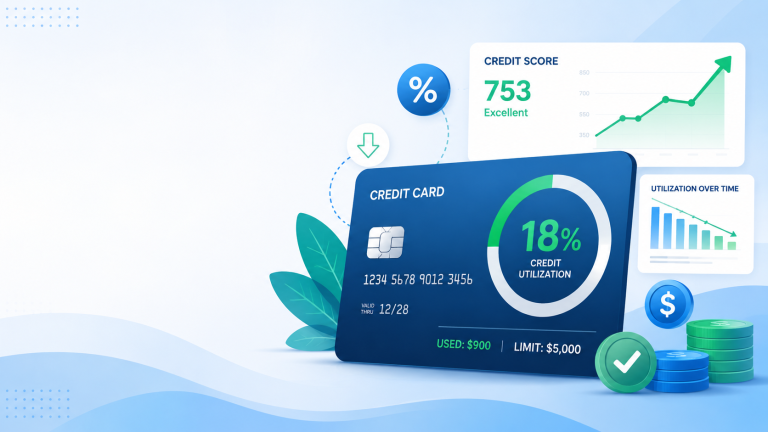
Credit utilization is the percentage of your available credit that you are using right now. You find it by dividing your total balances by your total credit limits. It is one of the biggest factors in your credit score, and keeping it low is one of the fastest ways to lift your score without paying off all your debt.
Most people never think about it until their score drops and they wonder why. The good news is that credit utilization is easy to understand and easy to fix. You do not need a special tool or a finance degree. You only need to know your numbers and a few simple habits.
This guide breaks down what a credit utilization means, how to calculate it, and what a good ratio looks like. You will also see what different rates look like in real dollars, and then learn the fastest ways to lower yours. By the end, you will know your target number and how to hit it.
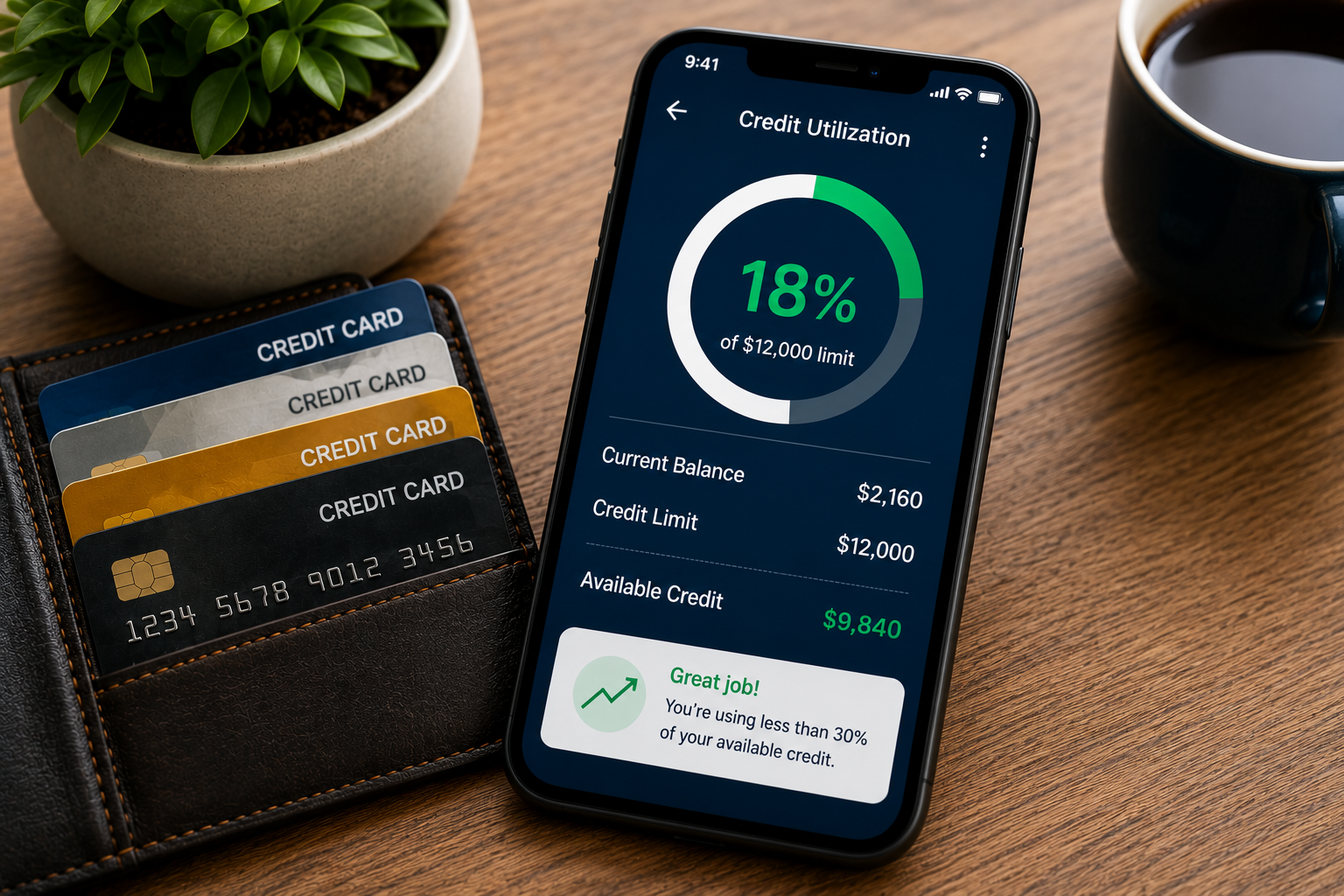 Credit utilization is the ratio of your credit card balances to your credit limits, shown as a percentage. Say you owe $2,000 on a card with a $10,000 limit. Your utilization on that card is 20%.
Lenders call this your credit utilization ratio. It is a simple way to measure how much of your available credit you lean on each month. A low ratio suggests you manage credit well, while a high ratio suggests you may be stretched thin.
Utilization only applies to revolving credit, like credit cards and lines of credit. It does not include installment loans such as a car loan or a mortgage, because those have fixed payments and work differently. So a large mortgage balance will not raise your utilization, but a large credit card balance will. This is one reason two people with the same total debt can have very different utilization rates. It also means paying off a car loan does nothing for this part of your score, even though it helps your finances in other ways. Credit cards are the accounts that drive this number, so they deserve most of your attention.
Your utilization is not fixed. It moves every time you spend or pay down a balance. Charge a big purchase and it climbs. Pay it off and it drops. That is why you can change it faster than almost any other part of your credit score. Think of your utilization as a snapshot, not a running average. Lenders look at the balance shown at one point each month, not everything you spent along the way. A single well-timed payment can change the picture, and we will cover that timing later. For now, just remember that both your balance and your limit shape the final number.
Credit utilization is the ratio of your credit card balances to your credit limits, shown as a percentage. Say you owe $2,000 on a card with a $10,000 limit. Your utilization on that card is 20%.
Lenders call this your credit utilization ratio. It is a simple way to measure how much of your available credit you lean on each month. A low ratio suggests you manage credit well, while a high ratio suggests you may be stretched thin.
Utilization only applies to revolving credit, like credit cards and lines of credit. It does not include installment loans such as a car loan or a mortgage, because those have fixed payments and work differently. So a large mortgage balance will not raise your utilization, but a large credit card balance will. This is one reason two people with the same total debt can have very different utilization rates. It also means paying off a car loan does nothing for this part of your score, even though it helps your finances in other ways. Credit cards are the accounts that drive this number, so they deserve most of your attention.
Your utilization is not fixed. It moves every time you spend or pay down a balance. Charge a big purchase and it climbs. Pay it off and it drops. That is why you can change it faster than almost any other part of your credit score. Think of your utilization as a snapshot, not a running average. Lenders look at the balance shown at one point each month, not everything you spent along the way. A single well-timed payment can change the picture, and we will cover that timing later. For now, just remember that both your balance and your limit shape the final number.
Does credit utilization apply per card or overall? It applies to both, so keep an eye on each card and on your combined total. To find your overall rate, add up every card balance, add up every credit limit, then divide the first number by the second. Doing this once a month takes only a few minutes. It keeps you ahead of any surprises before they show up on your report.
What is 30% of a $5,000 credit limit? It is $1,500. So on a $5,000 card, staying under 30% means keeping your balance below $1,500.
How much of a $500 credit limit should you use? To stay under 30%, keep it below $150. To stay under 10%, keep it below $50.
What Is Credit Utilization?
Credit utilization is the ratio of your credit card balances to your credit limits, shown as a percentage. Say you owe $2,000 on a card with a $10,000 limit. Your utilization on that card is 20%.
Lenders call this your credit utilization ratio. It is a simple way to measure how much of your available credit you lean on each month. A low ratio suggests you manage credit well, while a high ratio suggests you may be stretched thin.
Utilization only applies to revolving credit, like credit cards and lines of credit. It does not include installment loans such as a car loan or a mortgage, because those have fixed payments and work differently. So a large mortgage balance will not raise your utilization, but a large credit card balance will. This is one reason two people with the same total debt can have very different utilization rates. It also means paying off a car loan does nothing for this part of your score, even though it helps your finances in other ways. Credit cards are the accounts that drive this number, so they deserve most of your attention.
Your utilization is not fixed. It moves every time you spend or pay down a balance. Charge a big purchase and it climbs. Pay it off and it drops. That is why you can change it faster than almost any other part of your credit score. Think of your utilization as a snapshot, not a running average. Lenders look at the balance shown at one point each month, not everything you spent along the way. A single well-timed payment can change the picture, and we will cover that timing later. For now, just remember that both your balance and your limit shape the final number.
How Is Credit Utilization Calculated
The math is simple. Divide your total balance by your total credit limit, then multiply by 100. That gives you your utilization as a percentage. Here is the formula in plain words. Total balance divided by total credit limit, times 100, equals your utilization rate. Scoring models look at two versions of this number. The first is per-card utilization, which is the rate on each single card. The second is overall utilization, which is the rate across all your cards added together. Both matter, so one maxed-out card can hurt you even when your overall rate looks fine. Say you have three cards, and two sit at zero while the third is nearly full. Your overall rate might land near 30%, but that one full card can still weigh on your score. This is why spreading your spending across cards often helps. It keeps any single card from looking maxed out, even when your total debt stays the same. The table below shows how the same formula plays out at different balances.| Balance | Credit Limit | Utilization Percentage |
| $250 | $1,000 | 25% |
| $500 | $2,000 | 25% |
| $1,500 | $5,000 | 30% |
| $3,000 | $10,000 | 30% |
| $4,000 | $5,000 | 80% |
What Should Your Credit Utilization Stay Under
The common rule is to keep your credit utilization under 30%. Once you cross that line, your score usually starts to take a hit. So 30% is the number most people should treat as a ceiling, not a goal. Credit scoring models do not flip a switch at exactly 30%, but that line is a useful marker. The closer you creep toward it, the more your score can soften. Staying well below it gives you a cushion for the months when spending runs high. There is a second target that matters more if you want the best score possible. People who optimize their credit aim for under 10%. That is the range where scores tend to look their strongest. So you are really looking at two different targets, not one piece of advice repeated twice. Under 30% is safe. Under 10% is optimal. If you are rebuilding credit or just want to stay in good shape, aim for under 30%. If you are chasing a top-tier score for a mortgage or a car loan, push for under 10%. Zero percent is not the goal either. A small balance that you pay off each month can look better than reporting nothing at all, because it shows lenders you use credit and handle it well. Leaving a card unused for a long time can even lead the issuer to lower your limit or close the account. A tiny recurring charge, paid in full, keeps the card active and your utilization low. For most people, the sweet spot sits between 1% and 10%. That range shows steady, responsible use without stretching your limits. Which credit utilization rate would a lender prefer? A lender prefers the lowest rate you can reasonably show. On a credit card application, a lower ratio signals less risk, so under 10% looks stronger than 30%.What Different Utilization Rates Actually Look Like in Dollars
A percentage can feel abstract until you turn it into dollars. The same rate means very different amounts depending on your credit limit, which is why a flat percentage rule can confuse people. The table below shows what 10%, 30%, and 50% utilization look like at common credit limits. Use it to find the dollar amount that matches your own limit. Notice how the same 30% line means a very different amount at each limit. On a small card, 30% gives you only a little breathing room. On a large card, 30% still leaves you thousands in available credit. That gap is why a flat percentage rule can feel confusing until you see it in real dollars.| Credit Limit | 10% Utilization | 30% Utilization | 50% Utilization |
| $500 | $50 | $150 | $250 |
| $1,000 | $100 | $300 | $500 |
| $5,000 | $500 | $1,500 | $2,500 |
| $10,000 | $1,000 | $3,000 | $5,000 |
Why Credit Utilization Matters for Your Credit Score
Credit utilization falls under the amounts owed category in the FICO scoring model. That category makes up about 30% of your score, and only payment history counts for more. That makes utilization one of the strongest levers you can pull. Because it carries so much weight, a high ratio can drag your score down fast. A lower score often means a higher rate on future loans and cards, and over time that gap can cost you real money. If you are not sure how rates work, the difference between APR and interest rate is worth a quick read. The upside is speed. Unlike payment history, which takes months to build, utilization can improve in a single billing cycle. Pay down a balance and your next report can show a lower rate. Few other factors move that quickly. If you are new to all of this, a quick look at how credit cards work makes it clear why your balance and limit carry so much weight. Once you see the link between the two, keeping your ratio low becomes second nature.When Is Credit Utilization Actually Calculated
Here is the part most people miss. Your card issuer reports your balance to the credit bureaus on your statement closing date, not on your due date. The balance on that closing date is the one that shapes your utilization for the month. This matters more than it sounds. Say you pay your bill in full every month by the due date. You might still show high utilization if you carried a big balance on the closing date, because the bureaus saw that high number before you paid it down. To report a low rate, pay down your balance before the statement closing date. You can find that date on your monthly statement or in your online account. Paying early, before the statement closes, is the move that lowers the number lenders actually see. Set a reminder a few days ahead so you have time to send a payment. If you cannot clear the full balance, even a partial payment before the closing date helps. Every dollar you knock off lowers the rate reported for that month. Does paying off your card early lower your utilization? Yes, as long as you pay before the statement closing date. Paying after that date still helps your wallet, but it will not change the balance already reported that month.How to Lower Your Credit Utilization
You can lower your utilization faster than almost any other credit factor. Here are the moves that work best. Most of them cost nothing and take only a few minutes, and you can combine several at once for a bigger drop.- Pay down balances before your statement closing date. This is the fastest fix. A lower balance on that date means a lower reported rate.
- Make more than one payment a month. Splitting your spending into two payments keeps your balance low for the whole cycle. Some people call this the two-payment trick.
- Ask for a credit limit increase. A higher limit lowers your ratio even if your balance stays the same. Raise a $5,000 limit to $8,000 and the same balance suddenly looks smaller. If your issuer will not budge, opening the right credit card can add to your total available credit.
- Keep old cards open. Closing a card lowers your total available credit, which can push your utilization up. Before you cancel one, think about how many credit cards you should have and what closing one does to your numbers.
- Spread balances across cards. One maxed-out card hurts more than the same debt split across two. Moving a balance can help both your per-card and overall rate. Just avoid opening a brand-new card only to shuffle debt around, since a fresh application can ding your score for a short time.
- Consider a payoff plan for large balances. Rolling credit card debt into a fixed loan can drop your card utilization to near zero. Learn when debt consolidation is a good idea before you commit, and compare a debt consolidation loan versus a balance transfer to see which one fits.
Common Credit Utilization Mistakes
A few common mistakes quietly push utilization higher. Watch for these. Any one of them can undo the progress you make, so it helps to spot them early before they cost you points.- Closing a paid-off card. It feels responsible, but it cuts your total available credit and can raise your rate overnight.
- Maxing out one card while others sit unused. Your overall rate might look fine, yet that one high card still hurts your score.
- Assuming only the due date matters. The closing date is the one that shapes your reported utilization, so timing your payment is key.
- Ignoring a rising balance until it is too late. Letting a balance climb month after month can lead to missed payments and, in the worst case, a charge-off that stays on your credit report for years.
- Chasing a zero balance. Reporting nothing at all can look worse than a small, paid-off balance, so keep at least one card active with light use each month.