Einride pushes for driverless electric trucks on fixed freight corridors. Its system removes the complexity of urban navigation, instead focusing on predictable highway routes where safety, efficiency, and emissions are easier to manage.
This article covers Einride’s latest funding round and its recent historic cableless electric border pass.
Einride Raises $100 Million to Expand Electric Autonomous Freight Solutions
On October 1, Einride confirmed it secured $100 million in new funding. Backers include EQT Ventures and IonQ, a company focused on commercial quantum computing. The valuation was not disclosed.
Einride raised about $100 million in funds in a round that values the Swedish driverless truck startup at more than $1 billion, source says https://t.co/7bowQenJim
— Bloomberg (@business) October 1, 2025
This new round signals continued investor confidence in its fixed-route autonomy model, which limits complexity by operating only on freight-dedicated corridors.
The funds will also go toward increasing the deployment of Einride’s self-driving freight trucks, upgrading software systems, and onboarding additional enterprise clients.
This isn’t the company’s first significant raise. In 2021, it pulled in $110 million from backers including Maersk Growth and Temasek.
Furthermore, that same year, Einride moved into the U.S. market and signed contracts with GE Appliances, Oatly, and Bridgestone.
Einride Makes History With World’s First Autonomous Electric Border Pass
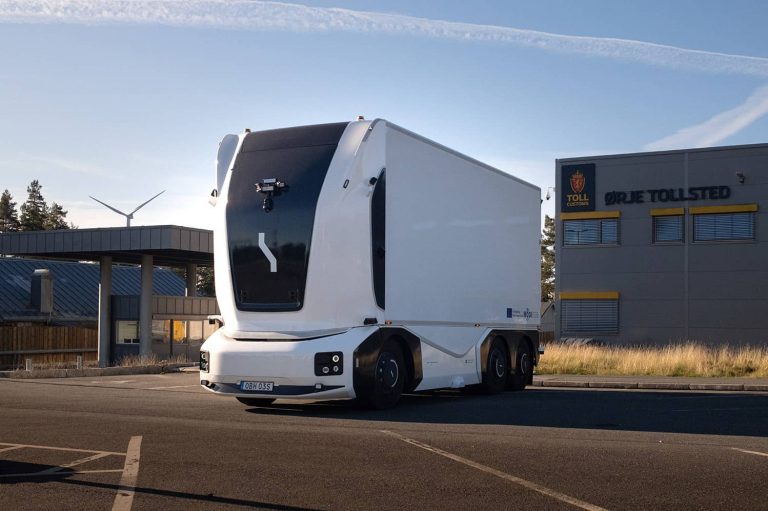
Einride announced on September 25 that it completed the first known cross-border operation of a fully electric, cableless autonomous truck with no human on board.
The vehicle crossed from Sweden into Norway at the Ørje customs checkpoint. It marked the first recorded instance of a self-driving, cabless freight vehicle crossing an international border under real-world conditions.
Additionally, cross-border operations remain one of the most complex challenges in autonomous freight.
Differences in national traffic laws, signage formats, and customs clearance workflows typically prevent driverless vehicles from making international trips.
Einride’s successful test showed that, under the right regulatory agreements, these barriers can be managed through system coordination and pre-approved protocols.
This demonstration was also part of the MODI project, a European Union-backed initiative focused on rolling out heavy-duty autonomous freight solutions across international corridors.
The project focuses on standardizing processes for cross-border traffic involving connected and automated freight vehicles.
Einride’s test directly contributes to that goal, offering proof of concept for scaled deployments across EU freight networks.
Conclusion
From a financial standpoint, continued backing from institutional investors signals confidence in Einride’s operational viability.
As regulators set clearer frameworks for autonomous freight, companies that demonstrate tested, real-world performance, especially across borders, stand to gain early access.
For more updates on companies like Einride and developments in autonomous freight and transport finance, subscribe to Financial Daily Update today.
Latest News
-
Vercel: $300M Funding, Solara6 Partnership & NuxtLabs Integration
-
Electronic Arts: $55B Buyout, Quarterly Earnings & Outlook
-
Oracle News: New Debt Plans and Leadership Updates
-
BitGo News: IPO Filing, OTC Trading Expansion, & Industry Momentum
-
AmEx News: Platinum Card Upgrades & Earnings
-
Roche News: 89bio Acquisition, CE Mark for Contivue, & Market Outlook
-
Groq: $6.9B Valuation and HUMAIN Partnership